August 20, 2026
Why we built an agent for Magento
Every few years something comes along that changes what you can do with Magento. Ari is the next one. Here is what it does, and why scandiweb is the one that built it.
12 minute read
Magento does not get better slowly. It stays the same for a few years, then something new turns up and everyone moves at once. Magento 2. The frontend rewrites. Hyvä. Each one took a job that used to be expensive and made it normal, and the stores that moved first got a head start on the ones that waited.
Two things were true every time. They came from people who build stores, and Adobe made none of them. Each one fixed a single expensive thing that everybody had stopped questioning.
Ari is the next one. You describe what you want in a sentence and Ari builds it on your store, using your catalog, your attributes and your theme. The actual change, ready to look at.
scandiweb built it for the same reason it built ScandiPWA, ReadyMage and Satoshi. It was the problem in front of the team, nobody was going to fix it for a mid sized store, and twenty years of Magento is what it takes to get it right.
Why this had to come from a Magento team
The AI tools of the last two years are genuinely good. Lovable is the best known. Describe an app, watch it appear, keep going until it is right. People who have never written code are shipping real software with it.
Every one of those tools starts from an empty page. Nothing exists yet, so nothing can break. If the result is wrong you throw it away and ask again.
A Magento store is the opposite of an empty page. Forty thousand products. Eleven attribute sets. Four payment methods, one of which behaves differently in Germany. An ERP feed somebody wired up in 2021 and never documented. A theme that was customized heavily three years ago by a developer who has since left. And it is taking orders while you work on it.
So writing the code was never the hard part. The hard part is knowing what is safe to touch, and showing that the change works before a customer sees it. You do not get that from a model. You get it from having worked on a few thousand of these stores and seen what breaks.
Making the change was never the hard bit. Everything between making it and a customer seeing it is the hard bit.
What Ari takes on
People assume this means small tweaks. It does not. Ari does the work a Magento team spends its year on, at full size.
- Version upgrades. Minor versions, major versions, security patches, module conflicts, and a full check that nothing broke afterward. This is the job most stores put off for years and quote in hundreds of hours.
- A full Hyvä rebuild. Hyvä installed, your design ported over, the old JavaScript taken out. Normally a project with a budget, a timeline and a steering group.
- ERP, carrier and CRM integrations. Field mapping in both directions, live shipping rates in the checkout, and the old systems that have no proper API.
- B2B and wholesale. Customer groups, tiered price lists, quote flows and trade only catalogs.
- Bug fixing and debugging. Broken checkout, fallout from a patch, the function that stopped working and nobody can reproduce.
- Storefront and theme work. Product pages, banners, content blocks, menus, layout and mobile UI, across every store view.
- Merchandising and pricing. Sort order, visibility, sale badges, search synonyms and cart price rules.
Ari does the small jobs too, and those add up, because they are the ones that never get to the top of the list. But the big work is the point.
A version upgrade, in detail
Upgrades are the clearest example because everyone in Magento knows what they cost. A store with real customization gets quoted four to six hundred hours of developer time. That makes it a project, the project goes on a roadmap, and the roadmap slips. The store stays several versions behind.
Ari runs the whole thing. Ari reads the installed modules and works out what each one needs. Where two extensions disagree about a version, it says so. Where one is abandoned upstream, Ari patches it to work or tells you plainly that it cannot, so you can decide whether to replace it or drop it.
Then Ari does the expensive part: checking nothing broke. Ari places a test order through every payment and shipping method you have switched on. Ari checks the admin can still see and export that order. Ari goes through the storefront pages the upgrade touched. Then you get a list of what actually behaves differently now, written out for you.
| The upgrade | Time |
|---|---|
| A security patch applied and checked | 9m |
| 2.4.6 to 2.4.7, minor version | 38m |
| 2.4.6 to 2.4.9, with three conflicts | 44m |
| 2.4.4 to 2.4.9, two majors, heavy customization | 2h 10m |
Two versions, three module conflicts, sorted and checked, in under an hour. The same job usually takes up a quarter of somebody’s year.
A storefront change, in detail
The second example is smaller, and it shows the other half of how this works. Ari builds on your real data.
The request below asked for a rebuilt coat product page with three additions. The size guide is built from the size attribute that already exists on the products. The delivery estimate is wired to the shipping table, so it is a real date for a real ZIP code. The bundle comes from ninety days of actual co-purchases in the store’s own order data.
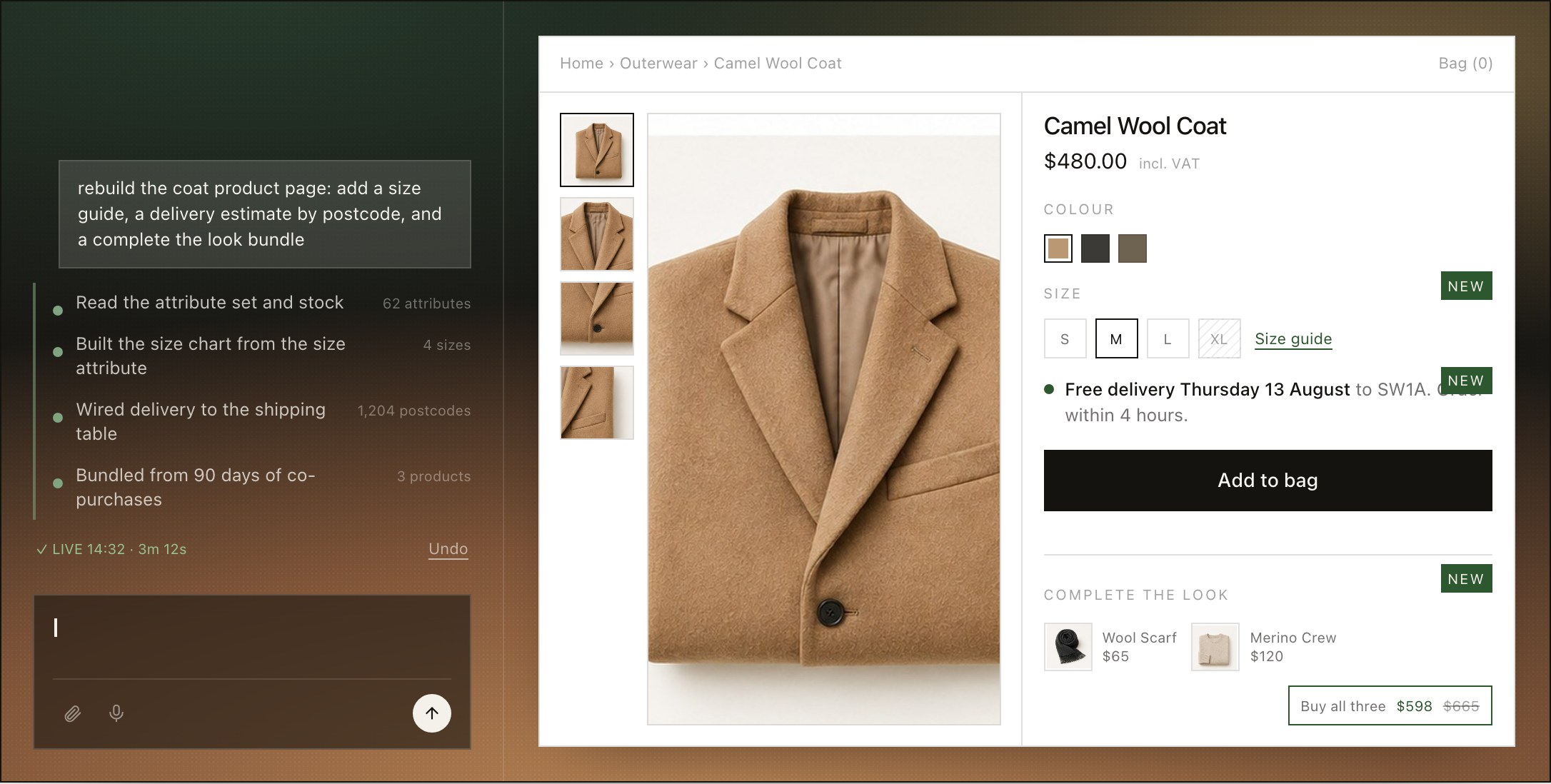
None of it is made up to look convincing. It is the real catalog, the real shipping setup and the real order history, so the preview is worth looking at.
| Storefront work | Time |
|---|---|
| A banner, two store views, one currency | 11m |
| A product page with size guide, delivery and bundle | 14m |
| Mobile UI fix, checked on two devices | 13m |
| A campaign page from a brief or a design | 16m |
| Navigation and layout across store views | 11m |
How it stays safe
Most of the work went here. It is what decides whether you can use something like this on a shop that takes real orders.
- Every change lands on a preview copy first. A working copy of your store on its own machine. Nobody outside your workspace can see it.
- One conversation is one change. Each chat is its own branch. Two chats cannot see each other, so a change you asked for in one is not sitting in another.
- Nothing reaches your live store until a person approves it. There is no automatic mode and there is not going to be one.
- If a request could mean two things, it stops and asks. Rather than picking one and hoping. Getting it confidently wrong is the expensive outcome.
- It hands work back. When a job needs somebody to make a decision rather than write code, it says so.
That last one costs us demos. It stays. Security and access covers what Ari can read and what it can never touch.
Why an extension could not do this
Worth stating plainly, because it is the question every Magento developer asks first.
An extension installs into your store and runs inside it. It goes out with your releases and lives with the same limits. That is fine for adding a feature. It does not work for something whose job is to change the store itself, because it has nowhere safe to do the work.
Ari works from outside the store instead. That is what makes the preview copy possible, and a separate branch for every conversation, and being able to throw a change away as if it never happened. How it works goes through it step by step.
What it is built on
Ari sits on two thousand one hundred eCommerce projects. Six hundred people hold close to nine hundred certifications between them. The Magento work behind it runs from single store businesses to enterprise builds for Puma, The New York Times, Land Rover and JYSK.
That is the hard part to copy. Knowing which changes are safe. Knowing which requests could mean two things. Knowing where a catalog will catch you out, which extensions fight each other, and what somebody actually wants when they ask for something that sounds simple. Ari is built around all of that, which is why it came from a Magento team and not from a startup that read the docs.
Ari runs on the newest models, and scandiweb is an official partner of OpenAI and Anthropic. scandiweb is also an Adobe Commerce Gold Partner and a Hyvä Platinum Partner, so whatever Ari does to a store, the team answers for it to both of them.
scandiweb has done this before
In 2018 most shoppers were on phones and most Magento storefronts were still built for desktop. There was nothing a mid sized store could afford, so scandiweb built ScandiPWA and gave it away. It was the first open source PWA theme for Magento and more than five hundred brands use it, most of them never scandiweb clients.
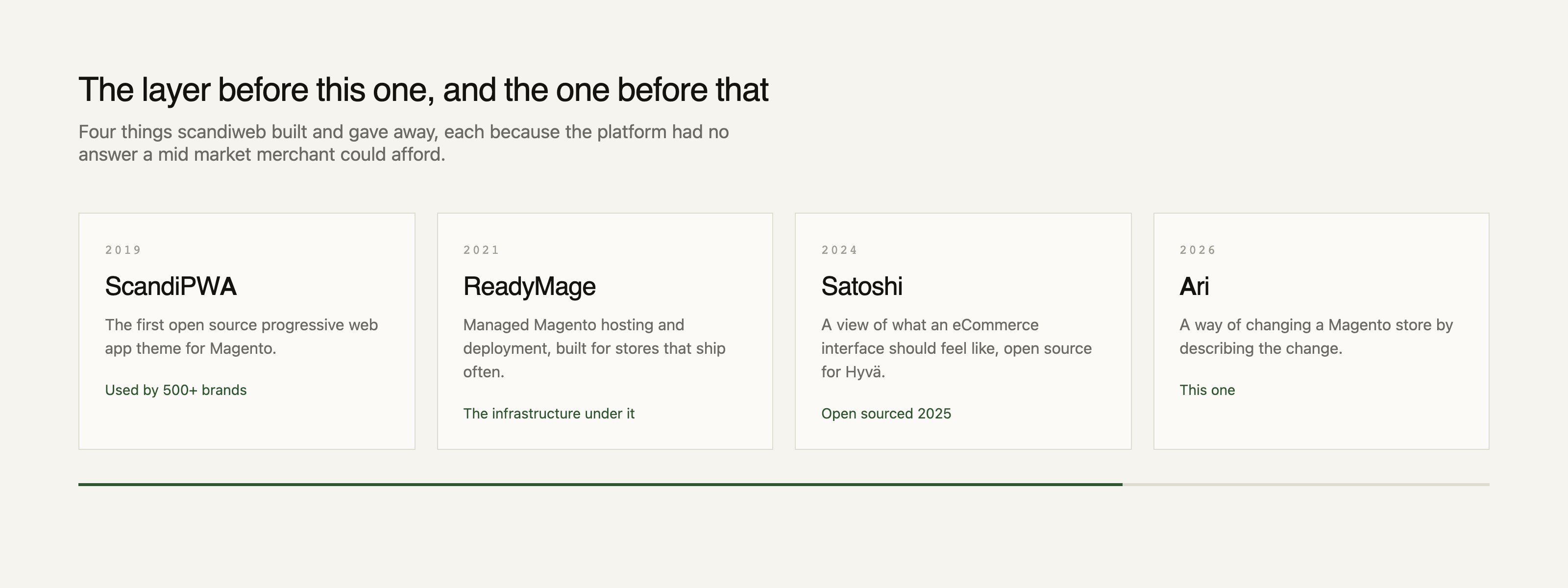
ReadyMage came next, because all of it needed somewhere good to run. Then Satoshi, which started as an argument about what a shop should feel like to use and is now open source for Hyvä. The story was the same each time. Something takes longer or costs more than it should, and building the fix is easier than explaining the problem again.
ScandiPWA taught the lesson that shaped Ari most. Something new only lasts if it works on real shops, with their undocumented integrations and odd catalogs. That is why so much of Ari is about preview copies and approvals.
Who built it
Alfreds Genkins is scandiweb’s CTO and the creator of Ari. He also created ScandiPWA and Satoshi, and works on ReadyMage. He started writing code at ten, joined scandiweb at sixteen, and is still here.

Each one started because something took longer than it should and he decided to fix it properly instead of working around it. Ari started with an argument about why a change that takes forty minutes to make takes a week to arrive.
What this does to the cost of running Magento
People are asking whether Magento is still worth the money, and the answer is mostly about developer time. Every hour spent on work a machine could do goes on the bill, and over a year that is the number that sends shops looking at simpler platforms.
Take enough of that out and the numbers change. You keep what Magento is good at: your own code, a catalog that does not have to fit somebody else’s template, B2B and B2C in one place. And you stop paying for it in developer hours every month.
Where it stands today
Ari is new. Some things on this site say Coming soon and that is exactly what they mean. Ari does not replace your developer, and where a store works with an agency it does not replace them either. Teams and roles explains how that fits together.
Everything else is ready to try now. The demo store is free and does not ask for a card. Start by asking it for a version upgrade, because that is the job most people assume is impossible.